Saturday, July 28, 2012
Getting Ready for India
I am getting ready for my first trip to southern India--Chennai and Goa--to participate in two professional meetings hosted by IAPCHE (the organization I work for). How do I prepare for such a trip? Well I have such a well organized colleague in India who has arranged my time in country so I guess I do not have to worry too much about it. That notwithstanding I still wonder what it will be like and what surprises will be in store for me. I am actually looking forward to tasting the local cuisine because of India's influence on east Africa's cuisine over the last hundred years after the British brought to east Africa Indian workers to build the Kenya-Uganda railway. It will be interesting to compare those local meals with what I am used to both here in the US and back home in Kenya. I also want to see how leadership in Higher education is experienced and expressed in India. In a country with the highest number of higher education institutions (31,324) in the world but third in the number of students in those institutions (at 14.6 million compared to China's 26.7 million and the US's 18.3 million) I am eager to see a little of the on-the-ground realities. What are some of the challenges facing higher education there and how does the leadership anticipate responding? What are some of the similarities and differences between Indian higher education and the US and Kenyan ones? Sure will be an interesting trip, I hope!

Sunday, July 8, 2012
Of Child Sponsorship
During my trip to Zambia in September
2011 I had a chance to witness the challenging realities of child sponsorship
programs. I was able to visit a community in Southern Province of Zambia
through the networks of a local Christian NGO. On the day of the trip to the
school that was part of the child sponsorship program managed by the NGO, we
traveled in three Toyota Land Cruisers along with some of the program officers.
When we arrived on site we were informed that we would be paired up with the
sponsored children at the school so we could help them write letters to their
sponsors. I remembered some examples I have had in the US where those who
sponsor children in a far away place really cherish the letters they receive
“from their sponsored children,” and wondered if it was okay that we would be
helping the children write the letters to their sponsors.
We arrived at the school and we were soon
a spectacle—all the students at the school stopped whatever they were doing and
stared at the visitors. One of the teachers at the school welcomed us into one
of the classrooms that had been emptied of ninth grade students who had been
studying pollination and hybrid agriculture. When we sat down we were briefed about
the procedure of the visit by one staff member from the NGO. He basically said
that he needed our assistance in helping the kids write letters to their
sponsors because the kids mostly did not speak very good English and needed
some help in constructing their letters to their sponsors. Our local guide told
the hosts the reason for us being there stating, “we want these students to
tell the sponsors that they have seen the sponsored children. The sponsors in
America want the kids to tell them if they have received the money sent to
them.”
I know a little about child sponsorship
because I have taught courses in community development that focus on that very
issue. I remember having my students read a book by Erica Bornstein on
development as implemented by faith based organizations in Zimbabwe titled “The
Spirit of Development.” When they finished reading a chapter on child
sponsorship they became so skeptical of the value of the program. I had to
intervene and help them see the value of the program especially when it is done
well and when all those that are involved clearly understand the cultural
contexts within which each operates (so as to sharpen their understanding of
expectations). In one such courses I remember a student asking me in class if I
knew why her aunt gets letters from sponsored children that look different (like
they are written by different people) and whose stories make no sense. This
question came after we watched a documentary about aid in Africa titled “What
Are We Doing Here?” in which one part showed children in a child sponsorship
program in Ethiopia where the monies sent from abroad did not go directly to
the kids sponsored but instead went to the family and community. The students
felt that this kind of arrangement was unethical because the organizations ask
for money on behalf of a child and then channels it to the community. The
argument by the community officer in the video was that when a community
changes for the better the child changes for the better. In other words the
child is a part of community and she/he is in that condition of need because
he/she is part of the larger system in the family and community. You cannot
seek to make his/her life better apart from her community unless you take him/her
completely out of her community. One the one hand the recipients of sponsorship
dollars know only too well that few sponsors will give money if they are told
it is to go to help a community. A child is a much more appealing “tool” to get
money from sponsors than a family or community. But children are part of
families and communities in which there are other members that are in need too.
On the other hand sponsors want direct communication with the children they
sponsor, they want to know how the money they send to the child is used and if
it has any tangible results in the child’s life.
Being at that school in
Zambia that day brought my students into a reality check. They were able to see
twenty individuals struggling to assist as many kids write letters to their
sponsors. I had a young girl who was in sixth grade named Steria. First of all
she did not respond to my questions and kept looking away and had her hand over
her mouth as she was talking to me when I pushed her to speak. I was told that
in the local culture being silent is a sign of respect as was averting one’s
gaze. The latter I am familiar with because it is common in many African
cultures that I am familiar with where a younger person does not look an elder
in the eye when talking. But here I was trying to speak with this sixth grader
who could barely speak to me or speak English. I was determined to help her
write to her sponsor. I had with me a pencil and a template of a letter to a
sponsor provided by the local NGO. Earlier on the program officer from the NGO
had mentioned that he writes the letters on behalf of many of the children. He
has a thousand children in the program so far and because the majority of the
kids cannot write the letters it made sense that he was the one who ended up
writing to their sponsors. In my case I had to literally tell Steria what to
write. At first I tried to ask her what she wanted to say to her sponsor but
nothing was forth coming. I wondered what her concept of her sponsor was and if
she ever imagined or even pictured what that person looked like or thought. A
colleague helping a young boy next to me did not have any luck either. I think
the boy ended up writing his letter in Chitonga (the local language). After
helping Steria write, “My name is Steria Munsaka I am in grade six,” I asked
her to write something else and she wrote “tgay seman,” telling me it was
something about her teacher. I knew we were going to spend the whole day on one
sentence. I had to actually show her the letters of the words I was asking her
to write. I remembered our youngest daughter who last year as a sixth grader was
reading books of more than 300 pages and here was a girl her age who could
write nothing else in English except her name. The inequality was astounding!
How does Zambia compete in the global market? I finally asked Steria to draw
something to be taken to her sponsor and she drew a girl and a boy. I then
showed her how to write “thank you” and asked her to write her name. That took
us 40 minutes to complete. If I were to expect that each child will really
write a letter to her sponsor and would need about 40 minutes then how do I
make sure a 1000 of them do so in a way that the sponsors can decipher the
intended messages? I know that there were a handful of students from 9th
grade that were quite ready to write and did a good job but the majority were
those who basically needed the letters written for them.
This scenario (which is
repeated in many communities all over Zambia) forces the NGO officer to become
the mediator between the sponsored child and the sponsor. And since the child
does not really have any tangible relationship with the sponsor the NGO representative
also decides what the sponsor needs to know about the child. I heard many of my
American students trying to share with the local students some of the things
they might consider sharing in their letters. They asked the local students
questions such as, “what do you love to do when not in school”; “what subjects
are you enjoying in school”; “what do you want to become after finishing school”;
“what sports do you play”; “tell me a little about your family,” etc? These are
the kind of questions an American child might consider important to answer
about self but I wonder how many of these kinds of questions really are part of
these local Zambian kids’ realm of experience? Given that the kids are given
gifts not money because the money goes to pay for costs related to their
livelihood what should they tell the donor? I asked the NGO program office
later what the kids get and he mentioned that they get supplies for school
including uniform and books as needed, medical care, and their families get
food, cooking oil, and other things such as a mattress for the child that
he/she is allowed to share with siblings.
How else do you assist a
child if not within the context of the household he or she is living? Can you
just buy food for the one child who is sponsored? But that is the reality of transnational development. It is
what I would call the “challenge of accountability” that requires individuals
that have been sponsored to report to their sponsors what direct benefits the
sponsorship has brought to their lives. It is expected that a sponsor should
make sure that money given is being put to good use of the child in whose name
the money is requested. However, we are dealing with two very different cultural
contexts: one is based on individual autonomy and the other is based on an
individual as an integral part of a community that works to achieve a common
goal. Standing out in such a community is not highly encouraged or even a
common reality. Given this scenario, therefore, my assumption is that to the
sponsor in America it is not enough to have a member of community write on
behalf of the child and say in general terms what the sponsorship has done for
the child and community he/she lives in (because no one sponsors a community
and yet the child exists in community). Even before these sponsored kids got to
worry about their education, they would have to have their other basic needs
met. Many of the children I saw in that school had signs of great economic
need; many had no shoes and their school uniform was torn. The school itself
has 571 students and only ten teachers (an average of 57 children per teacher)
and goes up to grade nine. The classrooms had dirt floors and some had no
windows or doors. How do these children really use education as their bridge
from their current status of poverty?
Friday, March 30, 2012
My Sojourn to New York

Episode 2:
After three days in Harlem I feel like I am getting a sense of the place eve though I have only been to a few locations. My highlight has to be having brunch at the Red Rooster restaurant in Harlem (picture on left) which is owned by chef Marcus Samuelsonn (http://marcussamuelsson.com/) who my family and I have watched and rooted for in a competition on food channel. The place was jam packed at 10:30AM and I was lucky to get a place to sit because I was alone; I was squeezed between two parties which made me feel a little awkward because I had no one to talk to and I did not wan to eavesdrop on other people's conversations. I decided to read world news from Al Jazeera on my iphone.
The other highlight was being part of an advisory group for the Museum for African Art that is planning an exhibit on African hip hop and the biggest challenge was how to plan and execute a show that tries to capture something as elusive (or is it called ephemeral) as music that changes every day (our meeting was on Saturday March 31, 2012). Do we include the debates over the origins of hip hop or the notion of African hip hop copying US artists? Do we have live music or music piped through speakers? Should we have still pictures or videos or both? Should we have images of certain objects associated with hip hop and what would those be? It is in thinking through these challenges that I think the museum staff will be able to put together a show that honors all these issues while giving audience members a slice of African hip hop as contemporary urban art form. I look forward to future conversations and to finally see the show itself. I have not been in such a meeting where the majority of the invited people were anthropologists--out of eight people invited excluding museum staff there were five anthropologists! What a delight!!!
Tonight (4.2.12) I am at the Shomburg Center for Research in Black Culture talking about African hip hop along with fellow anthropologist Jesse Shipley of Haveford. Should be an interesting episode tring to gauge what the audience may be like. The education director for the museum summed it this way: "We can anticipate a range of people in attendance, from those people who have a general interest in Africa to those who are from specific African countries and know about the political climate there; and from those people who like music but may not be familiar with highlife or the current hiphop scene, to musicians who have been actively involved in the New York hip hop scene." The best way to prepare for this kind of event is to NOT prepare at all and pray that the knowledge you have accumulated over the years of studying African music and hip hop will be enough to share and not look like a fool.
Episode 1:
It's Friday March 30th 2012 and I am on a trip to New York to be part of a consultation team for the Museum for African Art's project on African hip hop. My flight was scheduled to leave Grand Rapids at 6:02PM but was delayed till 6:30PM. We arrived in Cincinnati at 7:15PM and had to wait for a crew that was coming from Chicago. Our flight that was scheduled to leave Cincinnati at 7:55PM left at 10:10PM so I arrived in New York at 12:10AM (Saturday). Since I did not have any meetings scheduled on Friday I was not worried about the delays and catching a few naps in the airplane was not so bad. Arrival at the LaGuardia airport I went for a taxi and i was one of those famous yellow cabs where the driver does not open the door for you (I guess leaving in the small cities of the midwest I can get a little spoiled). Gave the driver my directions and sat back as I watched some potpourri of NBC shows on the small television screen in the cab. A commercial for Betty White's new show of senior citizens pulling pranks on younger people was the only interesting thing I saw.
Upon arrival at my hotel (Aloft Harlem on Frederick Douglas Blvd) I walked into a reception area adjacent to a pub where loud music was playing and the revelers enjoying their drinks as the danced and sung with abandon. What a nice welcome into the city. Thankfully my room is six floors above the club and so far I cannot hear the noise. I am looking forward to a few hours of sleep and then onto our consultation meetings in the morning (oh wait it is technically morning already).
Thursday, August 18, 2011

Sunday, July 17, 2011
Mutuuma Primary School Library

My work with Mutuuma School is not just in infrastructure but there is also the emphasis on academics. On the right here is a library built with help from friends Canton, NY and PA. Students use this library for reference work as well as for quiet study. we even installed solar power that many students used for studies and revisions after school before going home where many would not have light or time to study.
I also promised to pay tuition for high school to any student who scores 400 points and above out of 500 in the national examinations. So far no one has taken up the challenge. When I visited the school this June I was promised that this year might produce someone to take up the challenge. I am waiting to see.
Mutuuma Primary School

I have a soft spot for Mutuuma Primary School, the elementary school I attended many years ago as well as a school that both of my parents taught at and became principals. Since 1999 I have tried as much as possible and with the help of friends and family to give back to that school. Here I want to share some images of the slow but steady growth of the school's infrastructure over the years.
Here on the left is a view of how the school was prior to 1999. When we were in school it was not as good as this because we had mud walls in many of the classrooms. Here below is a shot of one of the trips I
 made with friends from Augustana College who supported the renovations of these and other classrooms. Some of the classrooms did not have windows (okay they had wire meshes) or doors. Here below you can see a shot of the school after we had completed major renovations to it. My thanks go to all my good friends across continents and family who have supported this endeavor. It means a lot to me and I want to continue supporting the school in whatever ways I can.

Giving advice to Mutuuma Primary School kids
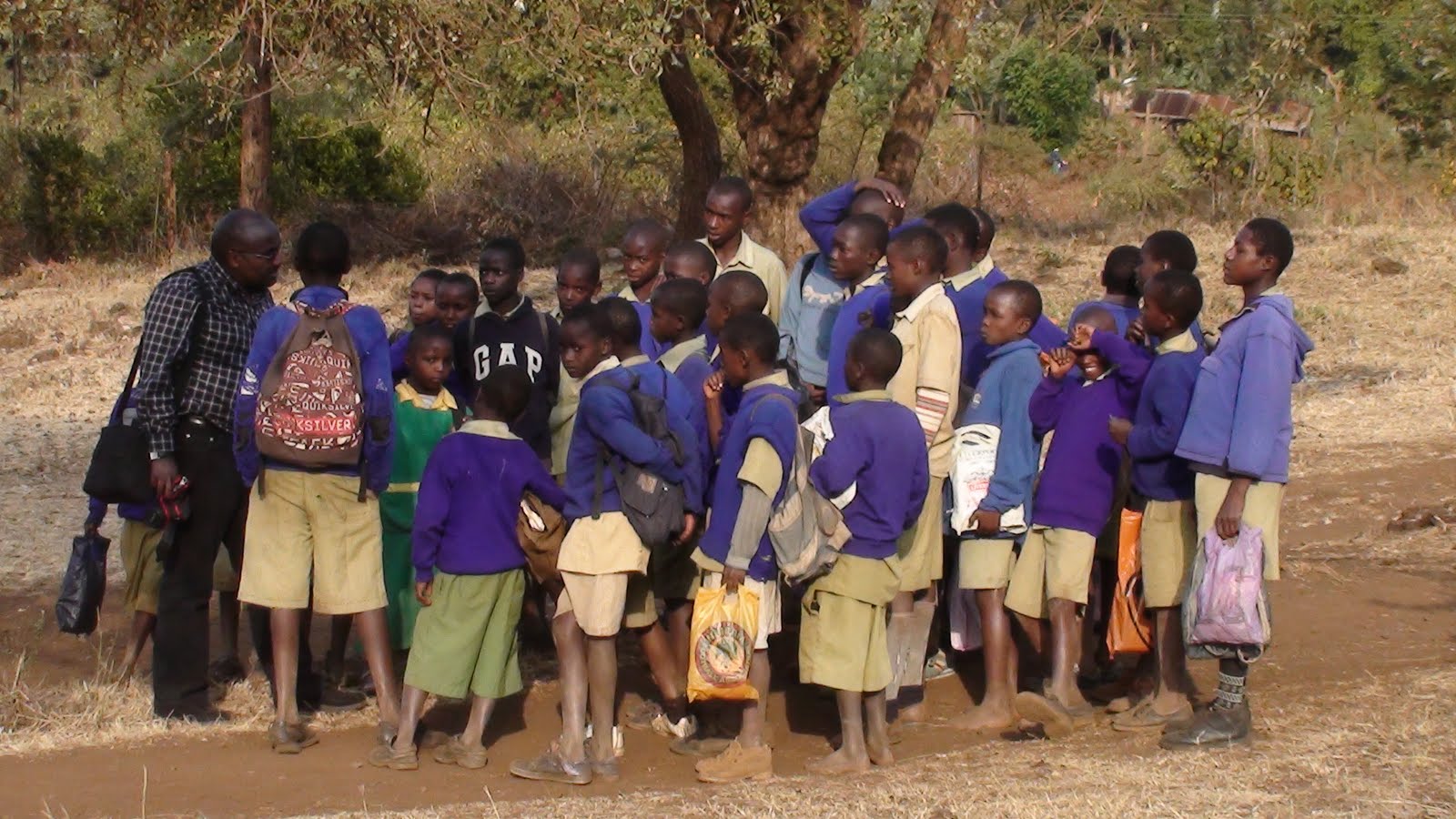 When I am in Kenya I try to visit my former elementary school and chat with the kids who all know me through the few projects I have been able to sponsor in the school. Seen here I am telling some seventh and eighth grade kids to work hard and go beyond the lives of their parents. I told them of my story when I was their age when I was working in our garden harvesting corn and the dry stalks were all hard to carry when the stinging hairs of the stalks were combined with my sweat. I promised myself to work so hard at school that I would never have to do that work for a living and would instead hire other people to do that for me. I hope this was inspiring to those kids especially to one named Mwenda who was very attentive to my pep talk.
Subscribe to:
Posts (Atom)